CHOOSING THE RIGHT FLOUR
Flour is not a one-size-fits-all ingredient. if you’re new to baking, or you’re expanding your baking repertoire, familiarizing yourself with the most common variations of flour is key to good results.
ALL-PURPOSE
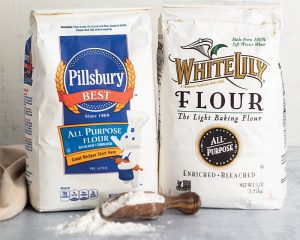
Also referred to simply as AP, this is the baseline of flours and a kitchen necessity. It’s the most accessible flour on the market, has a moderate protein content, and is versatile yet predictable, making it the most suitable choice for almost all your baking needs.
PROTEIN CONTENT: 9–12%
BEST USED FOR: Cookies, brownies, cakes, soft rolls, buns (almost everything!)
SELF-RISING
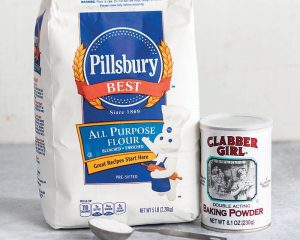
This soft all-purpose flour has baking powder, a leavening agent, and salt, which strengthens the gluten, mixed with it. This makes baking biscuits, quick breads, and more a cinch. But because of its additives, it has a shorter shelf life, so it should be used within 6 to 8 months after opening.
PROTEIN CONTENT: 8.5%
BEST USED FOR: Biscuits, quick breads, scones
CAKE
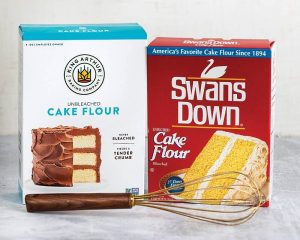
This finely milled flour has the lowest amount of protein among all flours. The superfine nature of cake flour gives it more surface area, which means it absorbs more liquid. Thus, when recipes call for a high ratio of sugar to flour, which we often see in cakes, this flour is able to accommodate the high sugar content while allowing the batter to rise nicely without collapsing. Like the name suggests, it’s best used for cakes that are traditionally light, fluffy, and tender, such as angel food.
PROTEIN CONTENT: 7–8%
BEST USED FOR: Cakes, cupcakes
WHOLE WHEAT
This type of flour is made by grinding, or milling, the entire wheat berry, including the germ, endosperm, and bran. This results in a higher protein content, a sturdier texture, darker color, and heartier flavor that’s great in hefty baked goods. White whole wheat flour is milled similarly but starts with a hard white wheat instead. Many consider this type of flour to be a healthier option due to the high percentage of protein and fatty acids that aren’t stripped when milled. But be sure to store it in a cool, dark place and replace it after 6 months since it becomes rancid more quickly.
PROTEIN CONTENT 11–15%
BEST USED FOR Crackers, pancakes, pasta
BREAD
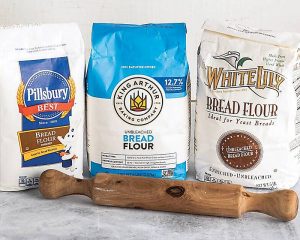
The strongest of all flours—meaning it has the highest protein content—and with remarkable chew, this flour works wonders in recipes that need strong gluten to make it rise. It gives great support to hard-crust breads and produces a nice brown top when baked.
PROTEIN CONTENT: 12–14%
BEST USED FOR: Pizza dough, yeast breads, bagels
PASTRY
This flour has a low protein content and fine texture, getting these characteristics from the soft white wheat (or soft red winter wheat) from which it’s made. On the protein scale, it lands between all-purpose and cake flours, making it quite versatile; it can produce tender crusts for holiday pies, as well as soft cookies and moist muffins.
PROTEIN CONTENT: 8–9%
BEST USED FOR: Pastries, piecrusts, cookies, muffins, biscuits
BLEACHED VS. UNBLEACHED
When grabbing a bag of all-purpose flour, you may have never noticed a small detail on the label: bleached or unbleached. For the most part, these two can be used interchangeably, but there are slight differences worth noting. The biggest difference is color, which reflects how they’re produced. All milled flour will have a slight yellow cast that eventually turns white when exposed to air and “aged” over time; this is unbleached flour. Some brands add chemicals to quickly and artificially age the flour to produce a whiter color, creating bleached flour. If tasted on their own, there isn’t much difference; however, your final baked good could be more noticeably affected. Bleached flour is softer and finer, so foods made with it are in turn softer in texture and lighter in color, which might be preferred when creating specialty bakes such as a white wedding cake. Unbleached flour is of -white and denser, generating more structure and texture.
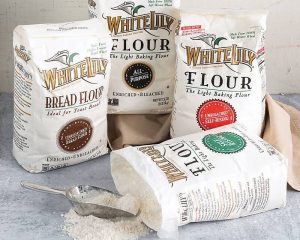
THE WHITE LILY WAY
If you’ve never lived in the American South, you likely have never heard of White Lily flour, but it’s the go-to for the Southern Cast Iron Test Kitchen and millions of Southerners when it comes to biscuit baking. Founded in Knoxville, Tennessee, in 1883, White Lily flour is ground from a specific variety of soft winter wheat with low protein, which is crucial for light and fluffy biscuits. It’s available in all-purpose and self-rising, as well as bleached and unbleached. Although White Lily is readily and widely available in the South, it can be hard to find elsewhere in the US. Visit whitelily.com/store-finder to locate a retailer in your area or to order online.